Why Your Code Reviews Are Broken — And What Chennai Developers Figured Out While You Were in Another Standup
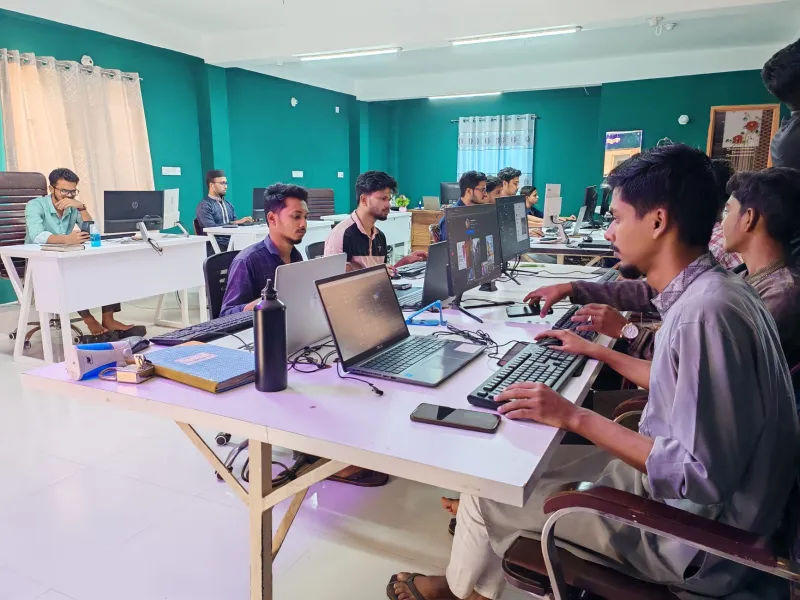
Photo: SSethi (WMF), CC BY-SA 4.0, via Wikimedia Commons
Let's be honest about something: most code reviews at US tech companies are a performance. A developer opens a pull request, tags a few teammates, and then the waiting game begins — a chain of quick approvals, half-read diffs, and rubber-stamp comments that rarely catch anything meaningful. Meanwhile, everyone's calendar is already stacked with syncs, standups, and sprint ceremonies.
There's a different story playing out in Chennai, though. And it's one that a growing number of American engineering managers are paying very close attention to.
The Problem With Always-On Review Culture
Real-time collaboration sounds great on paper. Shared screens, instant feedback, Slack threads that resolve in minutes — it feels productive. But the data tells a different story. Context-switching between coding and reviewing can cost developers anywhere from 15 to 30 minutes of deep focus per interruption. Multiply that across a team getting pinged for reviews throughout the day, and you're looking at a serious productivity hemorrhage.
The GDG Chennai community has been talking about this problem for years — not as a complaint, but as an engineering challenge worth solving. And when you're coordinating developer workflows across time zones, you have to solve it. The async-first environment isn't a workaround. It's a design constraint that forces better habits.
What Async Code Reviews Actually Look Like
Here's the thing about Chennai's approach: it's not just "do reviews when you get to them." That's not async culture — that's just slow culture. The difference is in the structure.
Developers in GDG Chennai's community circles have developed norms around what a reviewable pull request actually looks like before it even gets submitted. That means:
- A clear problem statement in the PR description — not just what changed, but why it changed and what problem it solves
- Self-review documentation where the author walks through their own logic, flags areas of uncertainty, and calls out specific lines they want reviewers to focus on
- Context links — relevant tickets, prior discussions, architecture docs, anything that lets a reviewer get up to speed without having to ping the author
- Explicit review scope — is this a logic check? A security pass? A style review? Reviewers shouldn't have to guess what kind of feedback is useful
When you submit a PR like this, you're not asking a colleague to drop everything and jump into your head. You're handing them a complete package they can engage with on their own schedule, deeply and thoughtfully.
The Cultural Shift That Makes It Stick
This is where a lot of US teams stumble when they try to copy the playbook. They adopt the templates and the PR checklists, but they don't change the underlying culture — the one that treats a slow response to a review request as a sign of disengagement, or that equates being online with being productive.
In Chennai's developer community, there's a different default assumption: if you need something urgently, you say so explicitly. Everything else gets handled asynchronously, and that's not a problem — it's a feature. The expectation is that a thorough review might take a day, and that's completely okay, because a thorough review is worth more than a fast one.
This cultural norm didn't appear out of nowhere. It was shaped partly by necessity — coordinating with global teams across time zones — and partly by the community-driven learning culture that places like GDG Chennai actively nurture. When developers gather to share knowledge, workshop problems, and discuss engineering practices, they develop shared vocabulary and shared standards. That's harder to build inside a single company's Slack workspace.
What the Numbers Are Starting to Show
American engineering teams that have experimented with structured async reviews are reporting some interesting outcomes. Bug escape rates drop when reviewers have the context they need to actually think through a change. Junior developers improve faster when PR descriptions force authors to articulate their reasoning — it's almost like having documentation baked into the review process itself. And senior engineers report fewer interruptions during their peak focus hours, which is where the most complex architectural thinking happens.
None of this is magic. It's just the compounding effect of replacing reactive, interrupt-driven workflows with intentional, structured ones.
The Documentation Dividend
There's a bonus that doesn't get talked about enough: when your async review culture is working, you accidentally build a knowledge base. Every well-documented PR is a record of a decision — why this approach was chosen over that one, what tradeoffs were considered, what edge cases were flagged. Six months later, when someone asks "why does this service work this way?" the answer is sitting right there in the PR history.
US teams that rely heavily on real-time, verbal code walkthroughs lose that institutional knowledge the moment the meeting ends. It never gets written down because it didn't need to be — everyone was in the room. Until they aren't. Until someone leaves, or a new engineer joins, or a system breaks at 2am and no one remembers why that particular function was written the way it was.
Chennai's developer community didn't set out to build better documentation habits. They set out to build better software with the constraints they had. The documentation was a side effect of the process.
What US Teams Should Actually Steal
If you're an engineering lead reading this and thinking about how to bring some of this into your team, here's the honest advice: don't start with the templates. Start with the conversation.
Talk to your team about what a useful code review actually looks like. Ask them how often they feel like they have enough context to leave genuinely helpful feedback. Ask them how often they approve PRs just to clear the queue. The answers will probably be uncomfortable, and that discomfort is where the real change begins.
Then look at what GDG Chennai's community events are actually doing: creating spaces where developers talk honestly about process, share what's working, and refine their craft in public. That's the engine behind the async review culture — not a checklist, but a community that takes engineering practice seriously enough to keep improving it.
The async code review revolution isn't really about being offline. It's about being intentional. And right now, some of the most intentional engineering thinking in the world is happening in Chennai — often while your team is still arguing about sprint velocity in a Zoom room.
Maybe it's time to take notes.