The Blind Spots No One in Silicon Valley Was Looking For — Until Chennai Found Them
There's a particular kind of problem that only surfaces when you're working at the edges — when you're building software for a market that doesn't behave like the textbook, serving users who don't fit the assumed profile, and doing it with infrastructure that wasn't designed with you in mind. Chennai developers know that space intimately. And it turns out, the solutions they've engineered there are exactly what some of the biggest names in US tech have been missing.
This isn't a story about outsourcing. It's not about cost arbitrage or offshore delivery teams. It's about a grassroots innovation loop that's been running quietly through communities like GDG Chennai — and is now getting a serious second look from CTOs who used to think their engineering org had everything covered.
Problems That Enterprise Software Forgot to Solve
When Priya Ramachandran, a backend engineer and regular GDG Chennai contributor, started building a payments reconciliation tool for small merchants in Tamil Nadu, she wasn't trying to disrupt anything. She just needed something that worked across inconsistent connectivity, mixed-language inputs, and transaction volumes that didn't justify a Stripe integration. There was no off-the-shelf answer.
So she built one. Shared it at a community workshop. Got feedback. Iterated. And somewhere along the way, she'd solved a problem that three US fintech startups were still circling around in their roadmap planning.
"We don't have the luxury of assuming stable infrastructure or uniform user behavior," Ramachandran says. "That constraint forces a kind of engineering creativity that I think gets underestimated from the outside."
That's the pattern showing up again and again inside GDG Chennai: developers solving for edge cases that enterprise vendors treat as out-of-scope, and in doing so, producing approaches that turn out to be highly applicable to problems US companies are actively struggling with.
The Reverse Engineering Moment
Ashwin Nair has been running workshops at GDG Chennai for the better part of four years. His specialty is low-latency data pipelines — specifically, making them work when you can't count on cloud proximity or consistent bandwidth. Last year, a US-based logistics company reached out after one of his open-source tools got traction on GitHub.
"They were dealing with fleet tracking across rural coverage gaps in the Midwest," Nair explains. "Same problem, different geography. What I'd built for Indian trucking routes translated almost directly."
The company didn't just adopt the tool. They brought Nair in as a consultant, then sponsored a follow-up session at a GDG Chennai event where his team could workshop the next version with community input. That's the loop in action: a grassroots solution, validated in a demanding real-world context, gets reverse-engineered by an enterprise team that had the budget but not the insight.
It's happening more than people realize. And US tech leaders who've stumbled into this pipeline are starting to talk about it openly.
What CTOs Are Actually Saying
The conversations happening in boardrooms and engineering offsites are shifting. A CTO at a mid-size SaaS company in Austin — who asked to stay unnamed because the internal discussion is ongoing — put it plainly: "We had three engineers working on an offline-first sync problem for six months. A developer from a Chennai community group had a working prototype in six weeks. We had to ask ourselves some uncomfortable questions about where our blind spots were."
Those uncomfortable questions are the productive ones. They point toward a structural issue: enterprise software teams often build for the median user in an assumed environment. The Chennai developer community, by contrast, builds for variance. For unpredictability. For the version of the problem that doesn't show up in the user research because the research didn't reach those users.
The result is a body of practical engineering knowledge that doesn't live in whitepapers or conference keynotes. It lives in GitHub repos, community Slack channels, workshop recordings, and the kind of informal knowledge transfer that happens when a hundred developers get together in a room to actually build something.
Why Grassroots Communities Catch What Labs Miss
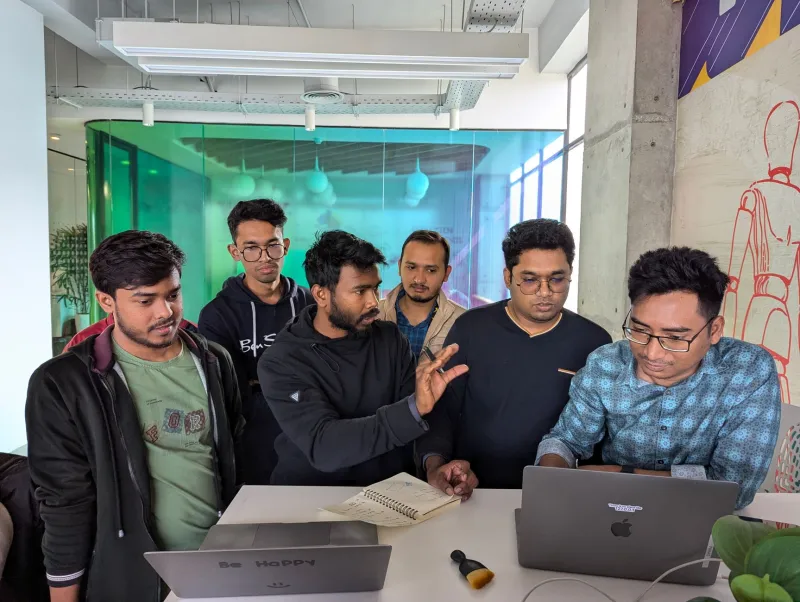
Corporate innovation labs have budgets, researchers, and structured methodologies. What they often lack is the messy, unfiltered contact with real-world friction that community-driven development provides. GDG Chennai events aren't polished product demos — they're working sessions where half the value comes from someone in the back of the room saying "that breaks when you do X" and someone else saying "oh, I already solved that, let me show you."
That culture of practical, immediate problem-solving compounds over time. Engineers who've spent years in that environment develop a kind of diagnostic instinct — an ability to spot the assumption buried in a system design that will eventually cause a failure the original team didn't anticipate.
And increasingly, that instinct is the thing US companies are trying to import.
The Pipeline Is Real, But It's Still Informal
Here's the honest part: this innovation pipeline doesn't have a formal structure. There's no official program connecting GDG Chennai's community output to US enterprise engineering teams. The connections happen through open source, through conference talks, through GitHub stars that turn into DMs that turn into consulting arrangements.
That informality is both the strength and the limitation. It means the pipeline is organic and self-selecting — the ideas that travel are the ones that genuinely work. But it also means a lot of valuable work stays local, undiscovered, because there's no systematic way for US teams to know what's being built and tested in Chennai's developer community right now.
Building that bridge more intentionally — through structured knowledge exchange, co-sponsored workshops, or even just better visibility into what grassroots communities are shipping — is an opportunity that's sitting largely unclaimed.
What Comes Next
For US tech teams willing to look, the signal is clear: some of the most practically validated engineering solutions to your current problems may already exist, built by developers who were forced to solve harder versions of those problems with fewer resources. The question isn't whether Chennai's developer community is producing valuable work. It clearly is. The question is whether your organization has the humility and the curiosity to go find it.
GDG Chennai is a good place to start looking. The community is open, the knowledge is being shared, and the developers here are genuinely interested in connecting with teams who take the work seriously. That's the whole point — build, connect, and grow. The direction of that growth, it turns out, runs both ways.