Why Decentralized Dev Communities Outperform Corporate Innovation Labs — And What GDG Chennai Proves About It
The Architecture Analogy Nobody Talks About
Here's a thought experiment: if you were designing a developer community from scratch, would you build a monolith or a set of microservices?
Most large US tech companies, whether intentionally or not, have built monoliths. Centralized innovation hubs. One flagship campus. One internal developer program. One pipeline from intern to senior engineer, all funneling through the same geographic and organizational bottleneck. It works — until it doesn't. Until a pandemic hits, until talent costs spiral, until the best engineers start choosing flexibility over prestige.
GDG Chennai has been running a very different experiment. And the results look a lot like what happens when you swap a legacy monolith for a well-designed API-first architecture.
What "API-First" Even Means for a Community
In software, an API-first approach means you design your interfaces before your internals. You build for extensibility. You assume that other systems — ones you haven't imagined yet — will need to connect with yours. The core stays stable, but the edges are open.
Apply that logic to community building and something interesting happens. Instead of designing every event, every mentorship program, and every workshop from the top down, you create contribution frameworks that let members plug in their own expertise. You build modular event structures — a talk format here, a hands-on lab format there — that can be recombined, remixed, and adapted without breaking the whole system.
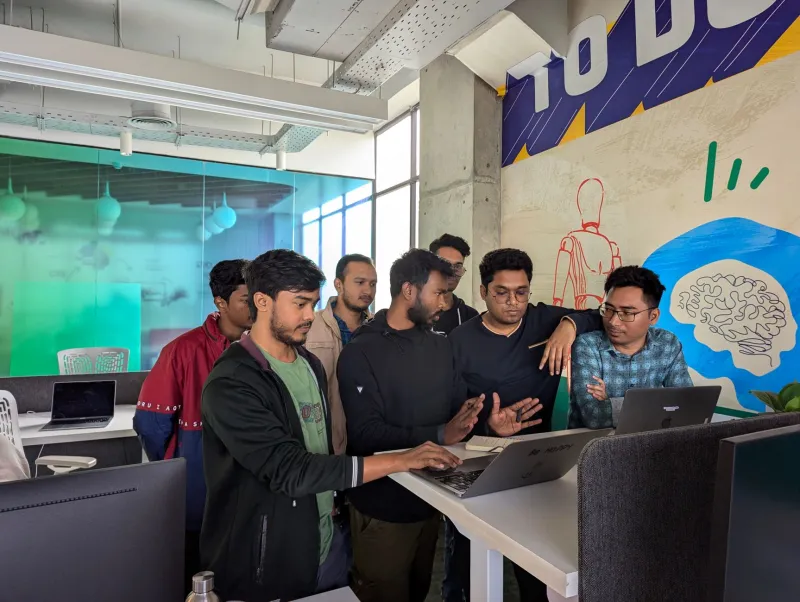
That's essentially what GDG Chennai has done. Workshops on Google Cloud, Flutter, and Firebase aren't handed down from a central committee. They're proposed, shaped, and often led by community members who saw a gap and had the tools to fill it. The organizing team functions less like a corporate events department and more like a platform — stable infrastructure that lets contributors build on top of it.
Modular Events as Scalable Units
One of the clearest signs of API-first thinking in GDG Chennai's model is how events are structured as reusable units rather than one-off productions.
A DevFest session in Chennai can be adapted and replicated in Coimbatore. A workshop format that works for a 30-person in-person crowd can be restructured for a 300-person virtual audience without rebuilding from scratch. The "interface" — the format, the agenda structure, the speaker brief — stays consistent. The implementation details change based on context.
For US tech companies that spend enormous resources producing custom, bespoke internal events that die on the vine after one showing, this is a genuinely different way of thinking. Community content in the GDG model is designed to travel. It's designed to be forked.
Open Contribution as a Feature, Not a Bug
Centralized innovation programs in corporate America tend to treat contribution as a controlled process. You apply. You're selected. You participate in the program as designed. Feedback is collected at the end, maybe incorporated next cycle.
GDG Chennai's contribution model is messier — and significantly more generative. Members propose talks. Developers who attended a workshop last quarter are running one this quarter. Someone who joined the community as a college student is now mentoring the next cohort of developers. The entry points are multiple, the paths are non-linear, and the community's collective intelligence compounds over time.
This is the open-source ethos applied to community building. And just like open-source software, the apparent chaos of distributed contribution actually produces more robust outcomes than tightly controlled alternatives.
The Resilience Test
Here's where the architectural analogy gets really interesting: distributed systems fail gracefully. When one node goes down, the others keep running.
The same is true of decentralized communities. GDG Chennai didn't collapse when in-person events became impossible in 2020. The community shifted online, the modular event formats adapted, and in some ways the reach expanded — because the infrastructure was never dependent on a single venue or a single organizing team. Compare that to the corporate innovation hubs that essentially paused for two years and are still trying to recapture their pre-pandemic momentum.
Resilience isn't a soft benefit. For US companies watching their innovation pipelines get disrupted by remote work, geographic dispersal, and talent redistribution, it's a strategic asset.
What US Companies Are Starting to Study
There's a growing conversation in American tech circles about decentralizing innovation — moving R&D investment out of Silicon Valley, building engineering teams in distributed locations, and rethinking what a company's developer ecosystem actually looks like.
Some of the most instructive case studies for that conversation aren't coming from McKinsey reports. They're coming from communities like GDG Chennai that have been doing decentralized, high-output community building for years without a Fortune 500 budget.
The plugin-style mentorship programs are particularly worth examining. Rather than assigning mentors top-down, GDG Chennai's approach allows mentorship relationships to form organically around shared interests, project types, and career stages. It scales without requiring central coordination — because the matching logic is distributed, not managed.
The Takeaway for American Tech Culture
If you're a US engineering leader trying to figure out why your internal developer community feels flat, or why your innovation programs keep underperforming their promise, the GDG Chennai model offers a useful diagnostic framework.
Ask yourself: is your community a monolith or a platform? Are you controlling contribution or enabling it? Are your events designed to be reused or consumed once and discarded?
Decentralization isn't just a technical principle. It's a community design principle. And the teams that figure that out — regardless of geography — are going to build the most resilient, most generative developer ecosystems of the next decade.
GDG Chennai figured it out. The architecture is open for inspection.